


Hot day, cold pool? What an El Niño summer means for your pool

Quick answer: A hot El Niño summer won't heat your pool for you. Adelaide still gets cool nights and sharp cool changes, and a pool loses most of its heat overnight through evaporation. The upside is that summer is the cheapest time of year to run pool heating. Heat pumps work most efficiently in warm air and solar has its best months. Where heating really pays off is in the weeks either side of summer, and in keeping the water steady when the weather swings.

What's the forecast for this summer?
The Bureau of Meteorology declared El Niño on 16 June 2026 (Bureau of Meteorology). Its 15 October long-range forecast says the event is likely to peak around November to December as a very strong event, and that maximum temperatures are very likely (greater than 80% chance) to be above average across much of Australia from November to January (Bureau of Meteorology long-range forecast). The water off southern Australia is running up to 3°C warmer than average too.
So it's shaping up as a hot one. That has a lot of pool owners asking the same thing: if it's going to be this hot, why heat the pool at all?
Why a hot day doesn't mean a warm pool
Adelaide's October shows the problem. At West Terrace, the Bureau recorded 29.6°C on Sunday 11 October. The next day only reached 17.6°C. Earlier in the month it went from 29.8°C on the 8th to 20.5°C on the 9th, and on the night of the 3rd it dropped to 8.7°C (Bureau of Meteorology daily observations).
Pool water can't follow swings like that. It takes a lot of energy to warm. A 50,000 litre pool needs around 580kWh to rise 10°C, as we explain in how long it takes to heat a pool in Adelaide. One warm afternoon barely moves it, and one cold night can undo it.
Three things work against you:
Nights. Adelaide's long-term average January minimum is 16.6°C (Bureau of Meteorology). Even if this summer's nights run warmer than usual, they still sit well below a comfortable swimming temperature.
Evaporation. It accounts for around 70% of an outdoor pool's heat loss (Poolwerx). Hot, dry northerly winds speed it up, so the hottest, windiest days can strip heat from an uncovered pool quickly.
Cool changes. The Bureau notes El Niño can increase the risk of extreme temperature shifts, like heatwaves and hotter days. In Adelaide that usually means a hot spell, then a sharp change, then a cold pool.
A pool blanket helps with all three. If you don't have one, start with our guide to using a pool blanket with solar or a heat pump.
The good news: summer is the cheapest time to heat

Here's the bit most people miss. A hot summer doesn't make pool heating pointless. It makes it cheaper.
Heat pumps pull heat out of the air, so warmer air means less work. Take the Guardian Lux V GLV-17. At 27°C air it puts out 17.5kW of heat at a COP of 6.4. At 15°C air it puts out 12.8kW at a COP of 4.6. COP is how many units of heat you get for each unit of electricity, so on a warm day the same unit gets nearly 40% more heat from every unit of power.
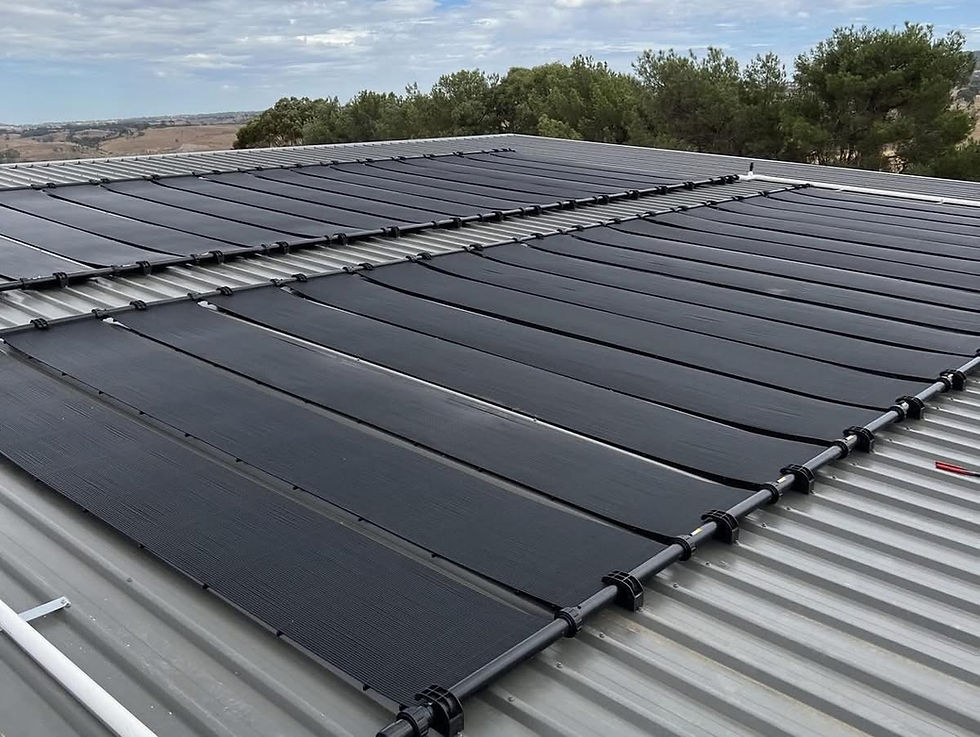
Solar has its best months now. Long, clear days mean your roof collectors do the heating and you only pay to run the pump. A solar pool heating system with a Zane PC5 controller compares the roof and pool temperatures and only runs the solar pump when it's worth it.
If you have a smart meter and you're on the Solar Sharer offer, you can also make the most of the free midday power. We break that down in running a pool heat pump on Solar Sharer.
Where heating really earns its keep
In the middle of a hot summer, an unheated pool can get close to comfortable on its own. The extra swims come from the edges of the season:
Late October to early December, when the days are warming up but the water is still catching up.
March and April, when the air cools faster than the water and an unheated pool drops away quickly.
After a cool change, any time of year, when heating keeps the water steady instead of losing a week of swims to a cold snap.
That's why we size systems around how and when you swim, not just the hottest month. Our heat pump sizing calculator and our solar vs heat pump comparison are good places to start.
Can a heated pool get too warm in a heatwave?
Not because of the heater. Heat pumps and solar controllers both let you set a target temperature, and they stop adding heat once the pool gets there. Set it to your preferred temperature.
What a heatwave does change is your water chemistry. Warm water and strong sun use up chlorine faster, so test your water more often during a hot spell.
Should you add heating before this summer?
If you only swim in January and February, a good blanket might be all you need. If you want to swim from October through to April, or the kids will be in the pool every weekend, heating is worth it, and summer is when it costs the least to run. Have a look at our pool heat pumps and DIY solar kits to see what's available.

We're family-owned and we've been heating Adelaide pools since 1979, with our own team on every install. Book a free onsite quote and we'll check your pool, roof and power, then tell you which option suits.
Frequently asked questions
Does El Niño mean a hot summer in Adelaide?
It usually brings warmer days to southern Australia. The Bureau's latest long-range forecast says maximum temperatures are very likely to be above average across much of Australia from November to January. Expect heatwaves and sharp cool changes, not steady warmth.
Why is my pool cold when it's hot outside?
Water takes far more energy to heat than air, and a pool loses most of its heat overnight through evaporation. One hot afternoon isn't enough to make up for cool nights.
Do I need pool heating in summer?
Not always in the middle of summer. Heating makes the biggest difference in spring, autumn and after cool changes, and summer is when it's cheapest to run.
Is it cheaper to run a pool heat pump in summer?
Yes. Heat pumps work more efficiently in warm air. The Guardian Lux V GLV-17 specs show a COP of 6.4 at 27°C air, compared with 4.6 at 15°C.
Can a heated pool get too hot?
Not from the heater, because heat pumps and solar controllers stop once your set temperature is reached. In a heatwave, keep an eye on your chlorine instead.


Comments